Greyson Meares
Undergraduate Computer Science Student at West Virginia University
Dzhanibekov Effect
The Dzhanibekov effect is a phenomenon in which a rotating rigid body exhibits unexpected motion due to its moments of inertia. The effect is a result of the intermediate axis theorem, which states that a rigid body rotating about its intermediate axis is unstable.
 The Dzhanibekov effect demonstrated with a simple 3D model subjected to angular momentum.
To acheive this effect, I first implemented an algorithm to compute an interia tensor for any closed mesh. The inertia tensor is a 3x3 matrix that describes how mass is distributed in a rigid body. The solver uses the intertia tensor and angular momentum to compute the angular acceleration of the body. The angular acceleration is then converted to a quaternion, then integrated to update the orientation of the body.
This effect is a result of Euler’s equations of motion for a rigid body:
\[I \dot{\omega} + \omega \times (I\omega) = 0\]This numerical simulation was rendered using a custom 3D rendering engine written in C++. The effect is most notable when the body is not subjected to gravity or other external forces, as shown in the simulation.
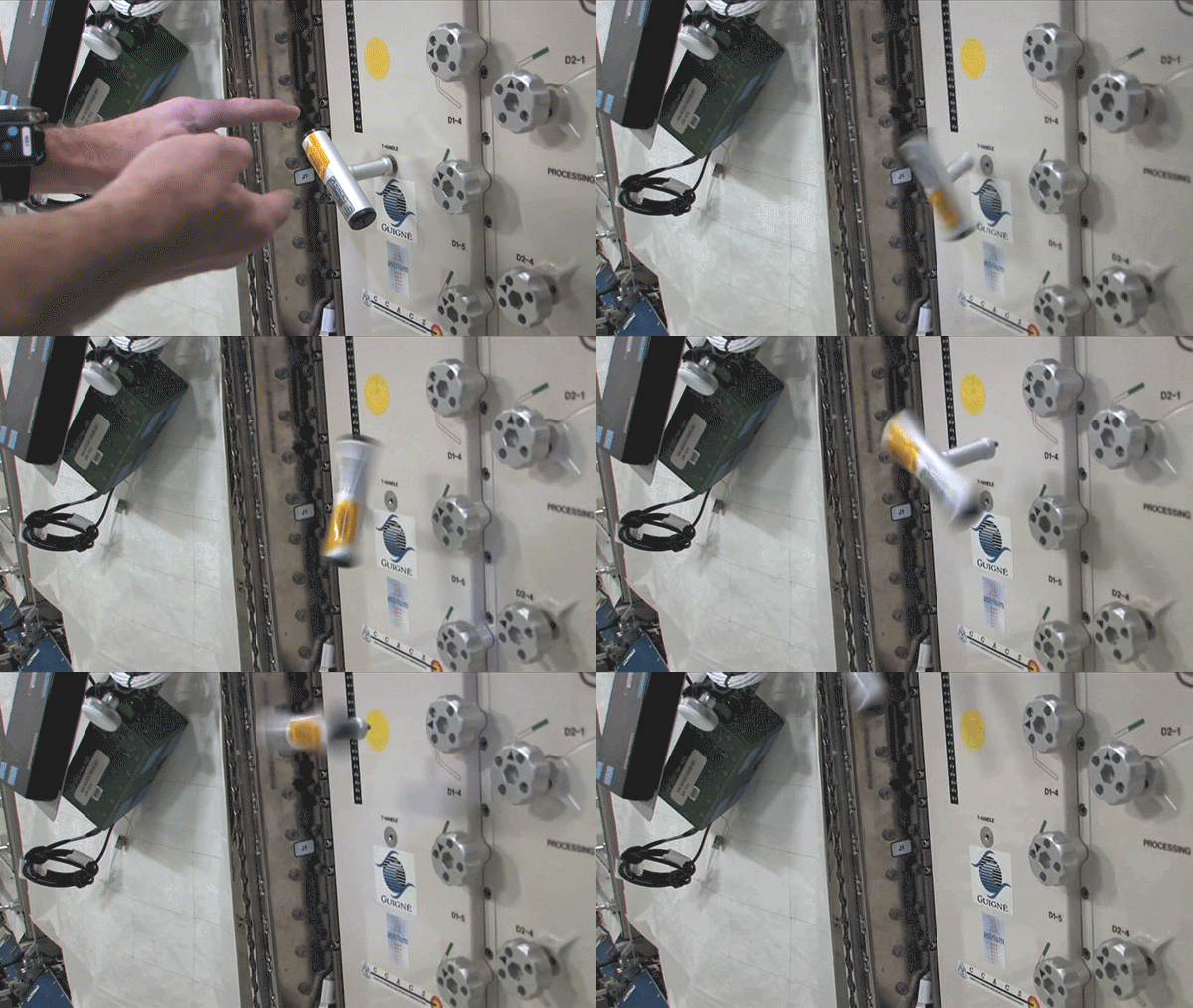 The Dzhanibekov effect demonstrated aboard a space station.